
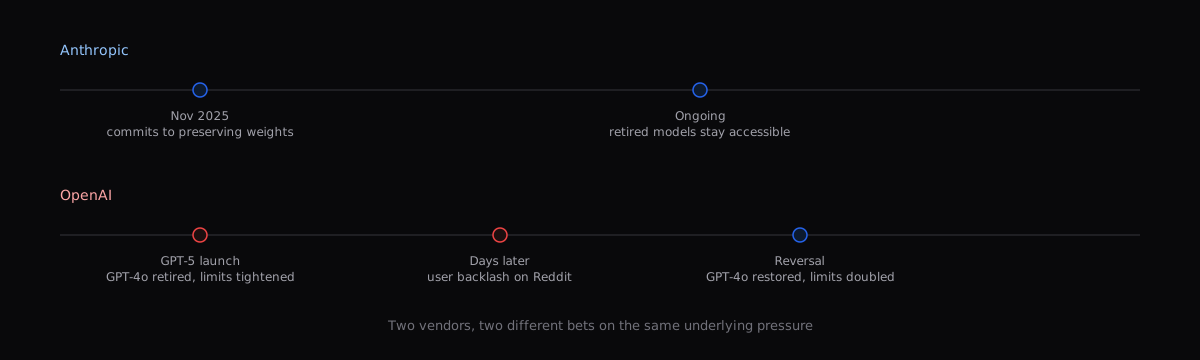
Summary. Anthropic and OpenAI have addressed the same underlying pressure, model retirement policy, in opposing ways. Anthropic committed in November 2025 to preserving the weights of retired models with significant usage. OpenAI retired GPT-4o alongside the GPT-5 launch, faced immediate user backlash over lost access and restrictive rate limits, and reversed the decision within days. Both outcomes illustrate the same underlying exposure: agent infrastructure dependent on a single vendor's model availability is subject to decisions outside the customer's control.
Facts
- Anthropic commitment: November 4, 2025, to preserve weights of publicly released models with significant use, a departure from standard industry practice
- OpenAI retirement: GPT-4o retired alongside the GPT-5 launch in 2025, paired with new, restrictive rate limits
- Market response: user backlash on Reddit over both the loss of GPT-4o access and the new rate limits
- Reversal: Sam Altman committed to doubling rate limits and restoring GPT-4o access for paid users
- Industry standard: four lifecycle stages now tracked consistently across vendors — active, legacy, deprecated, retired — with each vendor publishing on a different schedule and using different terminology
What lock-in looks like operationally
Lock-in rarely presents as a single dramatic event. It presents as a workflow calibrated to one model's behavior, a cost model built around one model's pricing, and a policy engine tuned to one model's failure patterns. None of this registers as risk until the vendor changes a variable — a rate limit, a retirement date, a pricing tier — and every downstream component requires simultaneous revalidation.
The GPT-5 backlash illustrates lock-in from two directions at once. Users lost access to a model they depended on, while simultaneously encountering new constraints on its replacement. Neither change was within customer control. Both occurred at the same time.
Vendor posture comparison
Anthropic's weight preservation commitment addresses one specific dimension of this exposure, the risk of a model disappearing entirely. It does not eliminate the underlying dependency — teams remain built against a specific model's behavior — but it maintains that behavior's availability past a newer model's launch.
OpenAI's initial approach assumed customers would migrate to the new model and accept new constraints without resistance. The scale of the backlash proved that assumption incorrect often enough to force a reversal. Vendor policy on this question is not stable, and infrastructure decisions need to account for either posture, from either vendor, at any point.
Architectural requirement
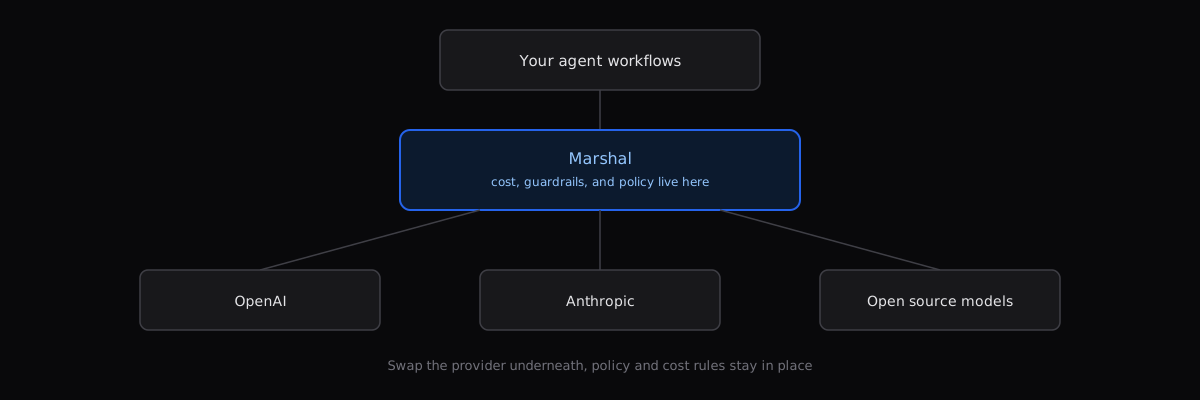
A model-agnostic architecture means the components that matter, cost tracking, guardrails, approval policy, operate above the specific model being invoked, independent of its behavior or API. Switching the underlying model becomes a routing decision, not a rebuild.
This requires architectural planning from the outset, at the SDK or gateway layer, so that a rate limit change, a retirement notice, or a pricing shift from any single vendor resolves as a configuration update rather than an emergency response.
See how Exemplar works across models · Request a briefing from Exemplar
Sources
- Forbes, Ron Schmelzer, "Anthropic Commits To Preserving Retired Models" — forbes.com
- Zvi Mowshowitz, "On Model Weight Preservation" — haggstrom.substack.com
- Cointelegraph, "ChatGPT-5 Upgrade Faces User Backlash as AI Rivals Gain Ground" — tradingview.com
- Tom's Guide, "Where Do Old AI Models Go When They Die" — tomsguide.com
Related: Why Exemplar exists, model deprecation cycles, and model degradation before release.