
Summary. Average AI model lifecycles have compressed from 18 to 24 months to 6 to 12 months. GitHub deprecated three models from Copilot in a single day, including Claude 3.5 Sonnet and GPT-5, requiring every dependent workflow to migrate on the vendor's schedule. Agent infrastructure built against a single model is exposed to a shrinking window of stability.
Facts
- Average model lifecycle: compressed from 18 to 24 months to 6 to 12 months, per research published May 2026
- GitHub deprecation event: three models removed from Copilot on February 17, 2026, including Claude 3.5 Sonnet and GPT-5
- Vendor cadence: OpenAI's deprecation pace runs faster than Anthropic's, though both have accelerated
- Reference point: GPT-4o's lifecycle from launch to retirement ran approximately two years, a pace now considered slow by current standards
- Counterpoint: Anthropic committed in November 2025 to preserving the weights of retired models, a public departure from standard industry practice

Deprecation velocity
Two years ago, a workflow built against a specific model could reasonably expect close to two years of availability. That window has effectively halved. Research published in May 2026 placed the current average lifecycle at 6 to 12 months, driven by competitive pressure to ship newer models faster and by the infrastructure cost of maintaining older ones.
The GitHub Copilot deprecation is the clearest concrete case. On February 17, 2026, GitHub removed three models in a single action, including Claude 3.5 Sonnet and GPT-5. Any workflow, integration, or pipeline referencing those models directly required migration on GitHub's schedule, not the customer's.
Downstream impact
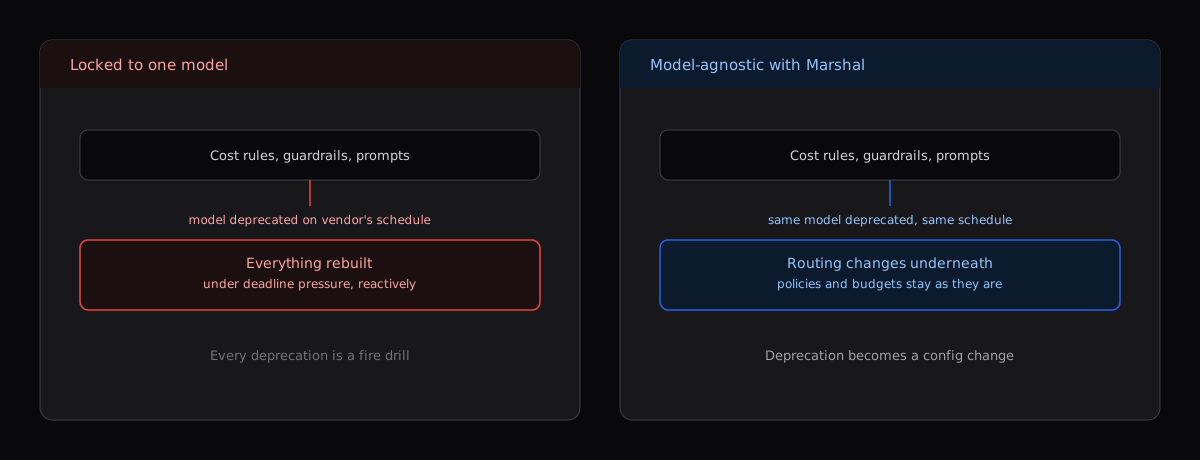
The immediate consequence: the API call fails. The operational consequence is broader. Cost projections calibrated to a specific model's pricing. Guardrail and policy logic tuned to a specific model's behavioral patterns. Prompt structures calibrated to a specific model's characteristics. All of it requires revalidation, and frequently reconstruction, the moment the underlying model changes or is retired.
Teams treating the model as a fixed architectural component absorb this cost reactively, under deadline pressure, at each vendor deprecation event. Teams treating the model as a swappable component behind a stable control layer absorb this cost once, and handle subsequent changes without disruption.
Building for deprecation resilience
The solution is architectural, not procedural. Monitoring deprecation calendars more closely improves reaction time but does not remove the underlying dependency. Removing the dependency requires a control layer positioned between agents and whichever model performs the work, one that handles cost tracking, guardrails, and approval policy independent of vendor or model version.
With that layer in place, a deprecation notice becomes a routing change rather than a reconstruction effort. Policy remains constant. Budget rules remain constant. Only the underlying model call changes.
See how Exemplar works across models · Request a briefing from Exemplar
Sources
- Presenc.ai, "AI Model Deprecation Tracker 2026" — presenc.ai
- GitHub Blog, "Selected Anthropic and OpenAI models are now deprecated" — github.blog
- MEXC News, "GitHub Copilot Drops Claude Opus 4.1 and GPT-5" — mexc.com
- Hidekazu Konishi, "AI Model Deprecation and Lifecycle Calendar" — hidekazu-konishi.com
- Forbes, Ron Schmelzer, "Anthropic Commits To Preserving Retired Models" — forbes.com
Related: Why Exemplar exists, vendor lock-in risk, and model degradation before release.